The three-layer principle
A well-stocked community tank uses the full water column. Fish are typically categorised as surface, mid-water, or bottom dwellers. Selecting species from each layer reduces competition for space, produces a visually dynamic tank, and means waste is processed at multiple levels.
- Surface layer: hatchetfish, killifish, some gouramis. These species often breathe atmospheric air and appreciate floating plants.
- Mid-water: most tetras, rasboras, barbs, danios, angels, gouramis. This is where most community fish spend the majority of their time.
- Bottom: corydoras, loaches, plecos, some cichlids. These species sift substrate and clean up uneaten food.
Key compatibility factors
Water parameters
The first filter for species selection is water chemistry. There is no point choosing a species that requires very soft, acidic water (discus: pH 5.5–6.5, GH 1–4°) if your tap water is hard and alkaline. Most aquarium shops in Poland stock species that have been tank-bred for multiple generations and are more adaptable than wild-caught fish, but extremes still matter.
A practical rule: if species from your shortlist all accept a pH range of 6.8–7.4 and GH 8–14°, they can coexist in unadjusted Polish tap water without special treatment.
Size and feeding behaviour
Any fish small enough to fit in another fish's mouth will eventually end up there. Angelfish at adult size (15+ cm tall) will consume neon tetras. In a community tank, a rough guideline is that the smallest species in the tank should be at least 40% the length of the largest. For example, angelfish pair well with species 5 cm or larger — black skirt tetras, lemon tetras, or rummy-nose tetras — rather than with neon tetras (3.5 cm).
Temperament
Some species are fin-nippers. Tiger barbs (Puntigrus tetrazona) are notorious for nipping the flowing fins of bettas, gouramis, and angelfish. Keeping fin-nippers in groups of 10+ redirects intra-species aggression and reduces nipping toward other species, but the risk never disappears entirely. Avoid mixing long-finned species with confirmed nippers.
Species profiles
Neon tetra — Paracheirodon innesi

Size: 3.5 cm. Water: pH 6.0–7.5, GH 1–10°, temperature 20–26 °C. Minimum group: 8, ideally 12–15. Layer: mid-water.
The neon tetra is the most widely kept tropical fish worldwide, partly because it is available everywhere and partly because its iridescent blue-and-red colouration is genuinely striking in a school. Despite a reputation as delicate, tank-bred neons adapt to moderate Polish tap water without issue. They are peaceful and mix well with similarly sized non-aggressive species. Avoid keeping with angelfish, larger cichlids, or any species above 8–10 cm.
Angelfish — Pterophyllum scalare

Size: 12–15 cm length, 20–25 cm height. Water: pH 6.0–7.5, GH 3–10°, temperature 24–30 °C. Minimum group: Single pair or group of 4–6 (odd number avoids one being isolated). Layer: mid-water, full height.
Angelfish are cichlids and display mild territorial behaviour, particularly during breeding. They occupy the full height of the tank, which is why a 50+ cm deep tank is a minimum. They are generally peaceful with fish too large to swallow. Good tank-mates include larger corydoras, plecos, rummy-nose tetras, and swordtails. Avoid small tetras, shrimp, and any fin-nipping species.
Dwarf gourami — Trichogaster lalius
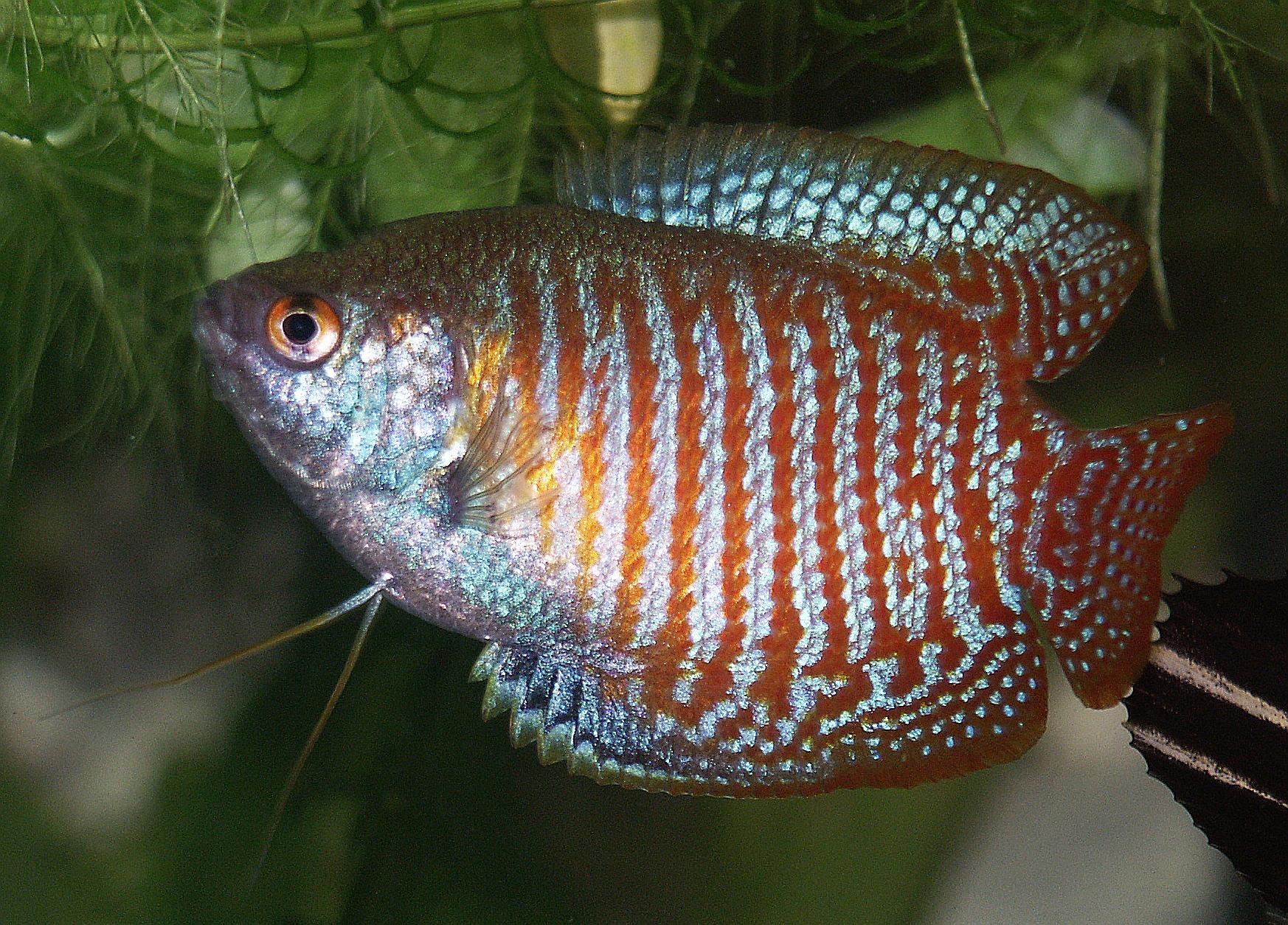
Size: 5–8 cm. Water: pH 6.0–7.5, GH 4–10°, temperature 22–28 °C. Minimum group: 1 male + 2 females, or single male. Males are aggressive toward each other. Layer: upper-mid water.
Dwarf gouramis are labyrinth fish — they breathe atmospheric air at the surface, so the space directly below the waterline must remain accessible. They are colourful and generally peaceful, though males will fight each other in a small tank. Keep with calm mid- and bottom-water species. Note: dwarf gouramis are susceptible to Dwarf Gourami Iridovirus (DGIV), a disease that has been prevalent in imported stock. Buy from reputable suppliers with known sourcing.
Bronze corydoras — Corydoras aeneus

Size: 6–7 cm. Water: pH 6.0–7.8, GH 2–12°, temperature 22–26 °C. Minimum group: 6, ideally 8–10. Layer: bottom.
Bronze corydoras are the most adaptable corydoras species. They accept a wide range of water conditions, making them compatible with nearly any community tank. They are active and social — a group of eight moving across the substrate is one of the most engaging sights in the hobby. Require smooth substrate (fine sand or small-grained gravel) to protect barbels. Feed sinking wafers or pellets; do not rely on them eating only leftovers.
Betta — Betta splendens

Size: 6–8 cm. Water: pH 6.0–8.0, GH 5–15°, temperature 24–30 °C. Minimum group: 1 male only (males fight to the death). Layer: upper-mid, labyrinth fish.
Bettas are often kept alone, but can coexist with the right tank-mates. Suitable companions include corydoras, small loaches, and non-fin-nipping tetras such as ember tetras or black neon tetras. Avoid tiger barbs, fin-nipping danios, and other labyrinth fish that a betta may perceive as rivals. A tank of at least 60 litres with dense planting gives the betta territory and visual breaks. Female bettas can be kept in groups (sorority tanks) but require careful observation.
Stocking combinations for 60–80 litres (Polish tap water)
The combinations below assume unadjusted Warsaw-area tap water: pH ~7.4, GH ~12°, KH ~7°, temperature 24–26 °C.
Combination A — peaceful community
- 10 × rummy-nose tetra (Hemigrammus bleheri)
- 8 × bronze corydoras (Corydoras aeneus)
- 1 male dwarf gourami (Trichogaster lalius)
All three layers occupied. Low aggression. All species accept moderately hard water. The rummy-nose school and gourami provide visual interest at mid- and upper-water; corydoras handle the bottom. Total bioload suitable for a 60-litre tank with a quality canister filter.
Combination B — angelfish centrepiece
- 2 × angelfish pair (Pterophyllum scalare)
- 12 × black skirt tetra (Gymnocorymbus ternetzi)
- 6 × sterbai corydoras (Corydoras sterbai)
Requires a 100-litre tank, minimum 50 cm tall. Black skirt tetras are large enough that angelfish ignore them; sterbai corydoras prefer the warmer temperatures angelfish appreciate (26–28 °C). Do not add any small (under 4 cm) fish to this setup.
Combination C — single-species focus
- 1 male betta (Betta splendens)
- 10 × ember tetra (Hyphessobrycon amandae)
- 6 × pygmy corydoras (Corydoras pygmaeus)
A quieter, lower-bioload setup ideal for a 60-litre planted tank. Ember tetras and pygmy corydoras stay small enough to avoid provoking the betta. Dense planting reduces betta aggression. All species accept pH 6.8–7.5 and GH 6–12°.
Combinations to avoid
- Cichlids + small tetras: most cichlids above 10 cm eat small schooling fish.
- Tiger barbs + long-finned species: bettas, angelfish, and gouramis will be nipped relentlessly.
- Goldfish + tropical species: goldfish require 18–22 °C; tropical fish require 24–28 °C. A compromise temperature stresses both.
- African cichlids + South American fish: African cichlids prefer hard, alkaline water (pH 7.8–8.5, GH 15–25°) incompatible with most South American species.
- Plecos + no driftwood: common plecos (Hypostomus plecostomus) need to rasp driftwood. Without it, they may rasp slime coat of other fish.
Article last updated: April 2026. Species parameter data cross-referenced with FishBase. Back to setup guide →